St James’ C of E Primary School Lower Darwen
Phonics
Welcome to the Phonics area of our website!
The subject leader for Phonics at St James' is Miss Bryan.
Christian Vision for Phonics
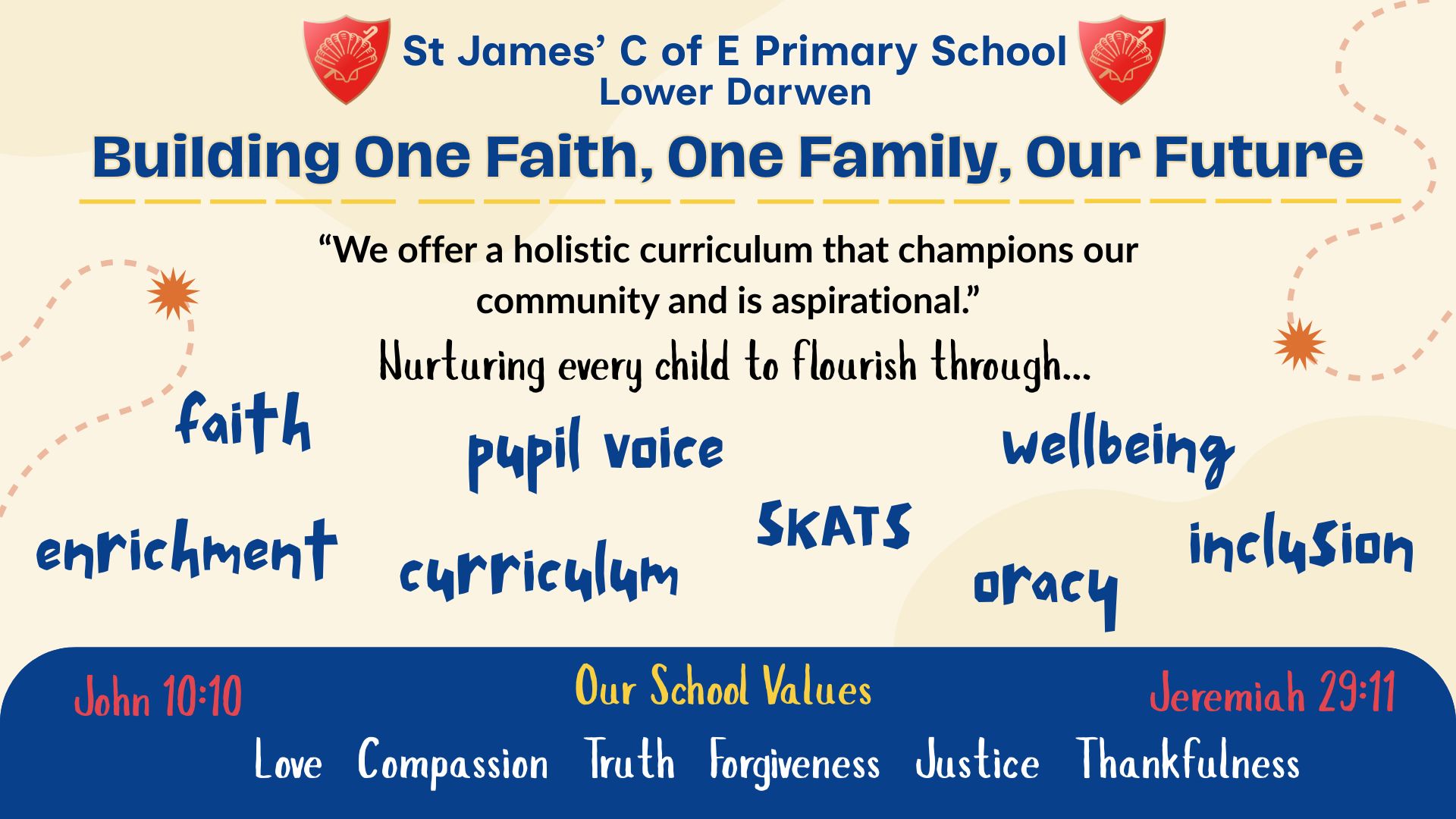
Our Phonics programme at St James’ aims to offer consistency for all children, following the same approach in all classes. We adopt a ‘keep up, not catch up approach’ to ensure that our phonics teaching is accessible to all of our children. Phonics at St James’ develops our children’s oracy skills through ‘asking the question’, giving children opportunities to enhance their speaking skills. We will aim to equip children with the tools they need to become confident readers and writers, giving them appropriate strategies to do so.
Within our phonics sessions we aim to enable our children to be more independent in their learning within other areas of the curriculum. Going at a pace that is achievable to our children, we will provide them with a multi-sensory approach to reading and writing, meeting the needs of all types of learners.
At St James' we have adapted Letters and Sounds to create our own systematic, synthetic phonics programme. The aim of our programme is to provide sufficient support for our children to become fluent readers. Children begin Phonics at the start of Reception year and continue across Key Stage 1 (Years 1 and 2). Every child between Reception and Year 2 has a 20-25 minute phonics session every day.
Our programme is separated into five Phases - your child's teacher will be able to tell you which Phase your child is currently working on.
If you require any further support, please come into school and speak with your child's class teacher or our Phonics co-ordinator, Miss Bryan.
Phonics Overview
At St James’, we believe that learning to read is one of the most important skills a child will ever develop. Phonics provides children with the building blocks they need to become confident, fluent readers and writers, opening the door to the wider curriculum and a lifelong love of learning. Through our systematic phonics programme, children are taught to recognise the relationship between letters and sounds, enabling them to decode unfamiliar words, develop spelling skills and read with increasing confidence and enjoyment.
From the moment children begin in Reception, they are taught the knowledge and skills needed to become successful readers. As they progress through the school, they learn to recognise and use a growing range of sounds, blend and segment words accurately, read with increasing fluency and apply their phonics knowledge confidently in their writing. Alongside phonics, children develop a love of books through high-quality stories, regular reading opportunities and meaningful discussions about what they have read. By the end of Key Stage 1, we aim for all children to become fluent readers who can confidently apply their phonics knowledge while developing strong comprehension skills that enable them to understand, question and enjoy a wide range of texts.
Phonics also supports children's wider development by building confidence, resilience and independence. We encourage children to persevere when they encounter unfamiliar words, celebrate their progress and recognise that mistakes are an important part of learning. Regular opportunities to read aloud, work with partners and discuss texts help to develop communication skills, vocabulary and confidence in speaking and listening. Through questioning, storytelling and book talk, children learn to express their ideas clearly, explain their thinking and listen respectfully to the views of others.
Our Christian vision of Building One Faith, One Family, One Future underpins everything we do. We believe every child is loved, valued and capable of success, and our phonics teaching reflects this through high expectations, nurturing support and a commitment to ensuring every child can flourish. By promoting our Christian values of love, thankfulness, truth, justice, compassion and fairness, we create an inclusive environment where children encourage one another, celebrate achievements and develop the confidence to become lifelong readers and learners.
Where does phonics begin at St James'?
Reception follows the EYFS framework, which is structured differently to the National Curriculum. Rather than being taught as a separate subject, the foundations for phonics are developed primarily through the areas of Communication and Language and Literacy, while also being supported through play, exploration and meaningful experiences across the wider curriculum.
In EYFS, children begin their phonics journey by developing strong listening skills, tuning into environmental sounds, rhythm and rhyme, and learning to hear and identify individual sounds in words. As they progress, they are introduced to letter sounds in a carefully planned sequence, learning how to blend sounds to read words and segment words for spelling. Alongside daily phonics lessons, children develop a love of reading through high-quality stories, songs, rhymes and regular opportunities to share books with adults and their peers.
Through engaging, practical activities and rich language experiences, children build the confidence to communicate, ask questions and apply their growing phonics knowledge in their reading and writing. The strong foundations established in Reception ensure children are well prepared to continue their phonics journey into Key Stage 1, where they develop into confident, fluent readers and writers with a lifelong love of books and learning.
Learn to Read with Phonics: A Parent's Guide
Phonics is a method of learning to read words that is taught from the start of Reception.
Read this guide to find out how your child uses phonics at school and how you can help at home.
https://home.oxfordowl.co.uk/reading/learn-to-read-phonics/
Phonics Audio Guide
There are 26 letters of the alphabet but they make 44 sounds. Use this audio guide to hear all 44 phonic sounds, on their own and in example words.
How to say the phonics sounds:
https://cdn.oxfordowl.co.uk/2016/05/05/20/22/32/561/20097_content/index.html?id=ae
Phonics Glossary
We hope the following glossary is useful to you when using our Letters and Sounds pages. Always feel free to come in and talk to us if you require any further support.
|
blending |
Blending is the skill of joining sounds together to read words. Children are taught to say the separate sounds in a word and to then blend them together to decode the word. |
||
|
digraph |
A digraph is a sound that is represented by two letters e.g. the sound 'a' in rain is represented by the digraph 'ai'. |
||
|
grapheme |
A grapheme is a visual representation of a sound e.g. a letter or a group of letters. Some sounds are represented by a single letter whilst others are represented by more than one letter. |
||
|
phoneme |
A phoneme is a unit of sound e.g. the word 'cat' contains three phonemes; c - a - t. |
||
|
segmenting |
Segmenting is the opposite of blending. Children are taught to segment a word into its separate sounds in order to spell it. |
||
|
split digraph |
A split digraph is a digraph that is separated by other letters e.g. the sound 'a' in the word take is represented by the split digraph a-e. |
||
Sequence of Progression Document
Phonics Mats
Miss Bryan has created phonics mats for each phase that will ensure consistency across all our infant classes. Each sound your child will learn has a picture and an action to match. Below you can see the order that the sounds are taught through each of the phases.


